A strike against the Pennsylvania Railroad in 1877 led to major destruction in Pittsburgh. The cause of the strike and the unrest that followed can be traced to the “Long Depression” which started with the Panic of 1873. A stock panic caused by what was likely the first “Economic Bubble” in U.S. History. The “Bubble” was due to over expansion and speculation in the railroad industry. The “Panic” caused the failure of the collapse of Jay Cooke & Company, a banking and investment firm with many European investors. These investors sold off their American Railroad bonds which crashed the market in Vienna (Austro-Hungarian Empire).
The “Long Depression” resulted in over 18,000 businesses failing between 1873 and 1875. This also resulted in a significant drop in the construction of new railroads. In 1872, the United States constructed nearly 7,500 miles of new railroad, by 1875 new railroad production had fallen to just 1,600 miles. By 1876. 76 railroad companies had failed, and Iron & Steel production in the United States had dropped to 45% of what it had been in 1872. As these smaller railroad companies failed, the era of the Railroad Baron’s began. These men bought up all the tracks and lines they could get their hands on.
In the Summer of 1877, a general strike against the railroad companies began. During the strike there were several violent clashes beginning in Martinsburg, WV. These clashes soon spread to Baltimore MD, Reading PA, Scranton PA. and Shamokin PA. There was an uprising without any major violence or injuries in St. Louis, MO. and a large uprising in Chicago IL that was very short lived.
Pittsburgh was by far, the pinnacle for violence during the strike. On June 1st, 1877, the Pennsylvania Railroad announced that they were cutting all employees making more than one dollar a day by 10%. They also stated that other cost-cutting measures would be coming. The Pennsylvania Railroad’s initial announcement caused a strike in Allegheny PA (Now the Northside of Pittsburgh), this strike did not more than a few days and it was localized to Allegheny.
The Pennsylvania Railroad later announced that they would be “double-heading” trains beginning July 19, 1877; double-heading was the process of connecting two trains to one engine with one crew to run the train. This would more than double the work, this would also increase the mileage for each train and crew. The Baltimore & Ohio Railroad announced that they would be cutting their employees wages beginning on July 19th. The Trainsmen’s Union was already beginning to organize their resistance to these changes, the railroads were backing the union into a corner.
On July 19th, a Pennsylvania Railroad Crew refused to take out their train on an early morning run. The company then contacted other workers to replace the crew that refused, the workers contacted refused. All of the train workers that refused were immediately terminated. Pennsylvania railroad sent a crew to try to take the train, but they were attacked by strikers and the crew retreated. The striking train workers then took over the stockyards along East Liberty Street (Now Liberty Avenue). by 9:00 a.m. The striking workers had control of the railyard and all of the traffic switches for the lines through Pittsburgh.
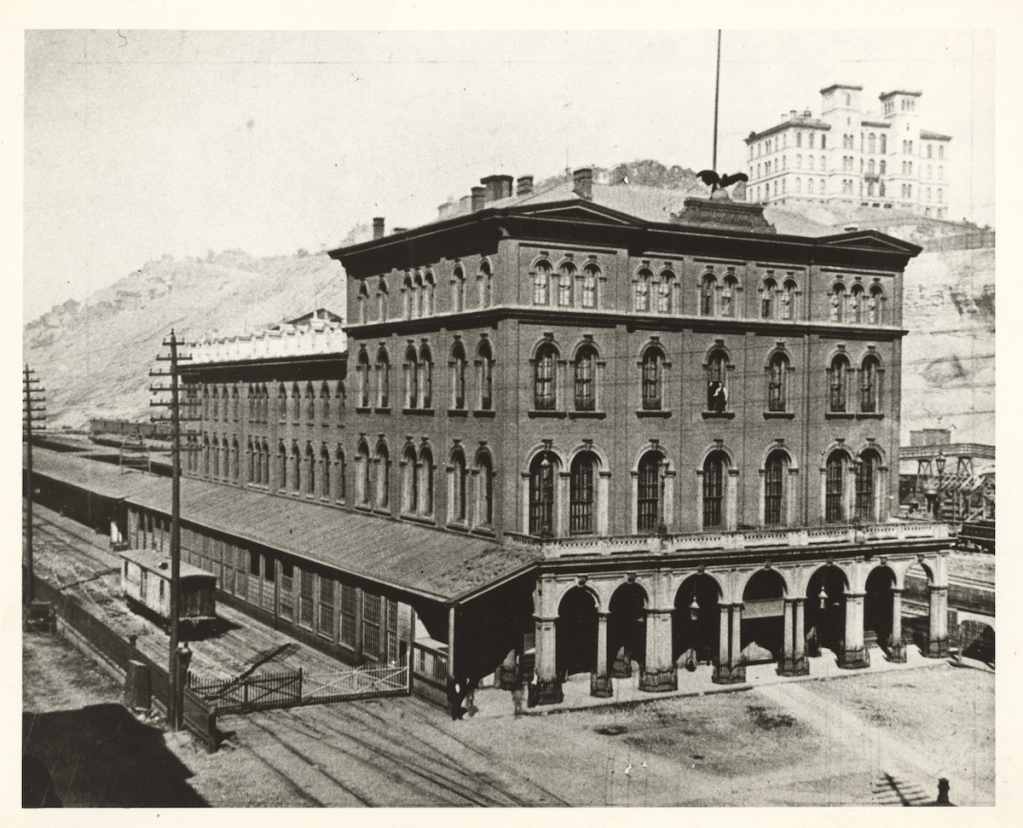
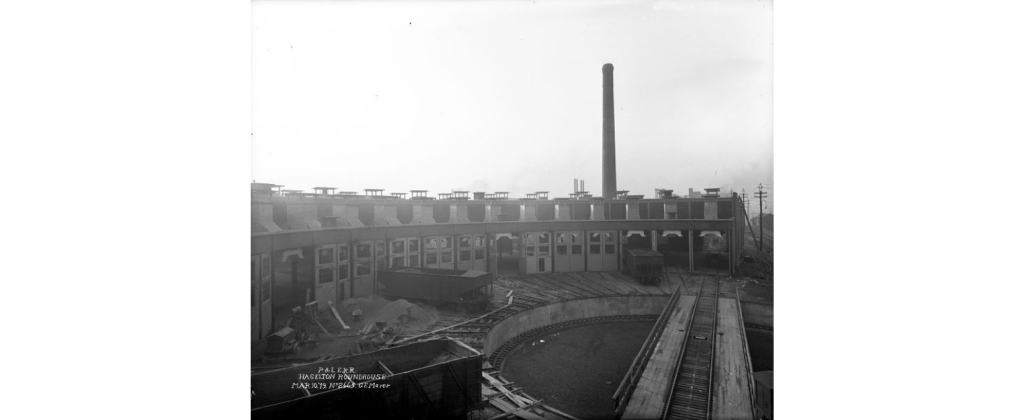
The stockyards can be seen at the back of the building. Built in 1857.
After the railroad had lost control of the yards to the striking workers, a message was sent to the Mayor of Pittsburgh, William McCarthy, asking for help removing the workers from the yards and clearing the tracks. There was a significant issue with this request; due to budget issues caused by the Long Depression, the city’s police force had been cut in half. The railroad agreed to pay some of the former city police officers, and the mayor allowed them to assist. After making one attempt to retake the traffic switch near 28th Street, the former police officers refused to move to the switch, Deputy Railroad Superintendent, Charles Watt, who had requested the police assistance attempted to take the switch on his own was bludgeoned by one of the striking workers, the police officers arrested the striking worker, angering the crowd even more.
Watt and the officers he hired then rode to the Torens Switching Station (Near where the MLK East Busway overpasses Fifth Avenue, in the East Liberty section of Pittsburgh) Upon the arrival of Watt and the officers, they found that striking workers were also in control of this station. After two attempts to get to the station Watt and the officers withdrew. Watt then contacted Allegheny County Sheriff R.H Fife. Later in the evening, Fife traveled to the 28th Street Yard, he ordered the striking men and their supporters to disperse. The striking men refused, and with out a significant force to back his order. Fife was forced to retreat. From his office, a telegram was sent to the Governor and Lieutenant governor of Pennsylvania requesting the Pennsylvania National Guard. By the next morning, the Lieutenant Governor ordered mobilization of the National Guard forces from Philadelphia to travel to Pittsburgh to enforce the Sheriff’s Order.
By midnight on July 19th, over 1,400 workers and supporters had gathered in several locations in Pittsburgh. The railroad yards were completely under the striker’s control and over 1,500 railroad cars sat idle in Pittsburgh, loaded with food, clothing, and other items with destinations around the country. Much of the railroad traffic from the northeastern United States to the mid-west ran through Pittsburgh. Overnight trains were arriving in Pittsburgh, however, they were carrying more striking workers and not commodities for the railroad.
On the morning of July 20, 1877, Sheriff Fire again ordered the crowd to disperse at the 29th street station. He was met with resistance and ridicule from the crowd. When the Sheriff had no success, General Pearson who had arrived in Pittsburgh with the 14th Regiment of the Pennsylvania Nation Guard, announced to the crowd that the Governor had given an order for the tracks to be cleared and the trains be allowed to go through. Pearson then told the crowd that the soldiers were carrying weapons and live ammunition.
Pearson however, did not have the backing of his soldiers, a situation that would only grow as the 18th Regiment was the deployed to Pittsburgh. The 18th Regiment were the Duquesne Greys, known for their service in the Mexican War and the American Civil War. The Greys were a respected unit in the area. At this point the Pennsylvania National Guard consisted of independent units who volunteered to assist the community. The Duquesne Greys being a local unit may have had more familiarity with the area, but also had more sympathy to local workers. Pearson hoped that the crowd would be more likely to follow the orders of a local unit. In the time that it took the Greys to arrive, over 1,000 more striking workers had arrived on trains controlled by the striking workers.
On the evening of July 20th, Adjutant General James Lamatta sent a telegram to Major General James Beaver of the Pennsylvania National Guard stating, “Situation in Pittsburg is becoming dangerous. Troops are in sympathy, in some instances, with the strikers. Can you rely on yours?” In the early morning hours of July 21st, The First Division of the Pennsylvania National Guard were sent from Philadelphia, including around 600 soldiers and officers. These troops were more heavily armed, each soldier was given twenty rounds of ammunition, the unit also brought two Gatling Guns, used for rapid fire. The First Division arrived in Pittsburgh at around 1:30pm. Upon their arrival, roughly 12,000 striking workers and supporters now occupied the areas near the Pennsylvania Railroad Building and Union Railroad Depot between 11th Street and 28th Street (Modern day Downtown and the Strip District).
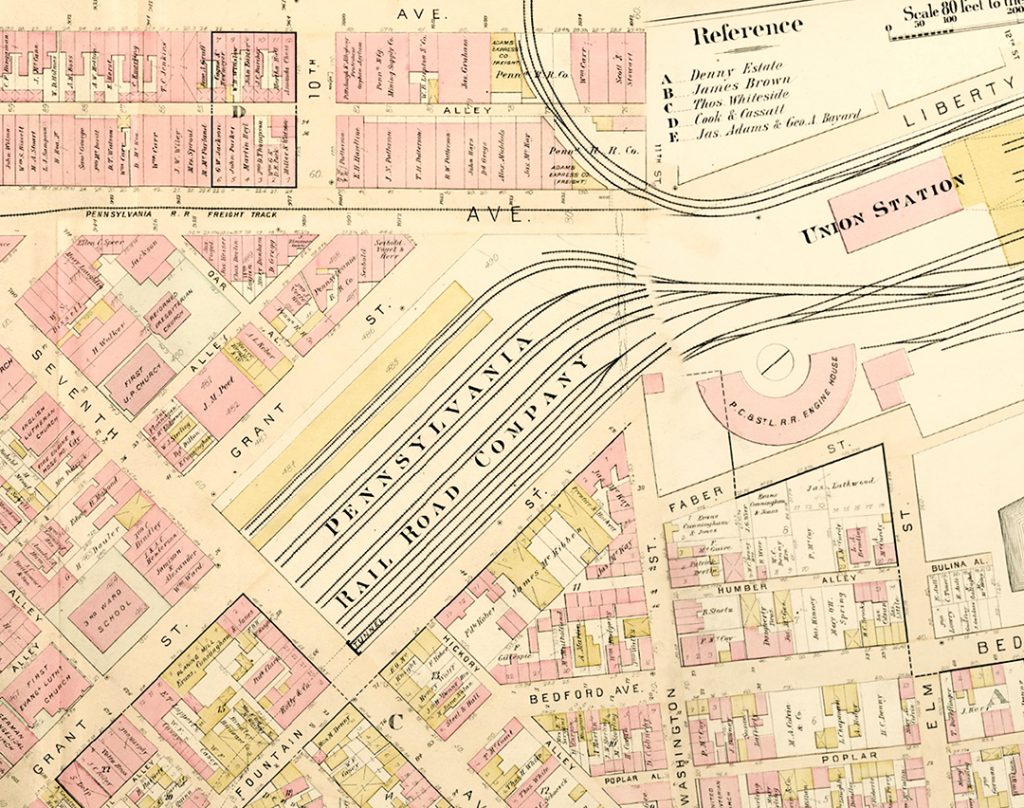
An 1889 map of Pittsburgh showing the Pennsylvania and Union Railroad depots. These tracks have since been replaced by a new Pennsylvania Station, which is now an apartment building and events center, and the Federal Court House in Pittsburgh.
Around 3:00pm the First Division was order to advance on the Pennsylvania Railroad outer depot along with Sheriff Fife and some of his deputies. Sheriff Fife attempted to deliver a writ of dispersal to the crowd and use the National Guard and deputies to arrest the strike leaders here. They were met with resistance and cries from the strikers to hold their ground. The soldiers were told to fix bayonets and advance on the crowd. Strikers and their supporters began to throw rocks and fire pistols at the soldiers. The troops began to return fire with a first shot that was not ordered by commanders. The firing continued in vollies over the next ten minutes. When firing ceased, 20 people, men, women and children were dead, another 30 were injured. Within minutes the crowd returned angrier and more determined. The news of the killings spread through the region within hours. By 6:00pm, the National Guard troops were given orders to retreat.
Workers from all over the city and nearby towns rushed home from their factories for pistols, muskets and butcher knives. 600 workingmen from nearby Temperanceville marched in with a full band and colors. In some cases the crowd organized itself into crude armed military units, marching together with drums. Civil authority collapsed in the face of the crowd; the Mayor refused to send police or even to try to quiet the crowd himself. Workers raided local shops for supplies. According to an article in Harper’s Weekly, ” A large crowd broke into the manufactory of the Great Western Gun-Works, and captured 200 rifles and a quantity of small-arms, and various other crowds sacked all the other places in the city where arms were exposed for sale, getting about 300 more. Among them were 1,000 mill hands from Birmingham, on the south side.” The strikers were organized and getting support from other union workers from around the region.
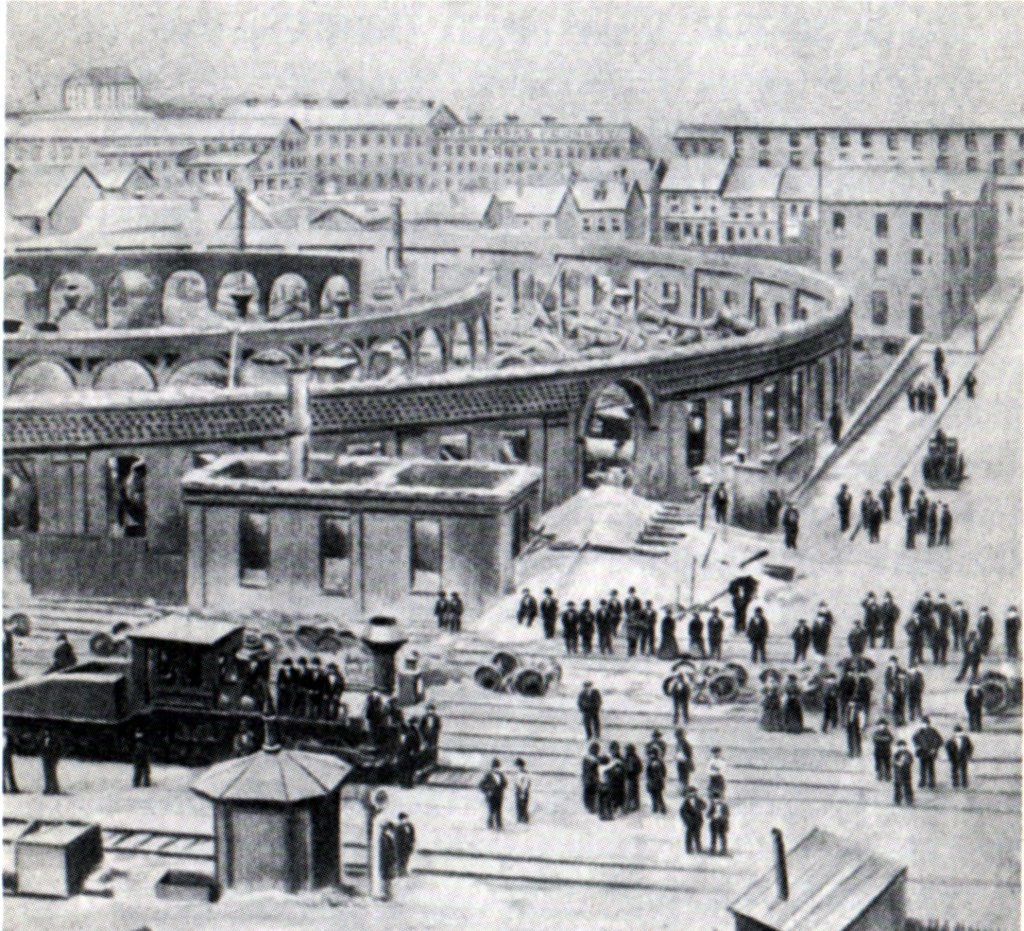
Striking workers began to set fire to railroad cars and equipment, when firefighters arrived, they were chased away at gunpoint. A group of soldiers from Philadelphia who had been surrounded by strikers, the soldiers retreated to a roundhouse nearby. By late that evening the roundhouse was surrounded by thousands of strikers, none of whom got close due to the soldiers being armed. Before daylight on July 22nd, the roundhouse was on fire. The soldiers were able to escape, and they were pursued by the strikers from the roundhouse near 33rd Street into the neighboring Borough of Lawrenceville (now part of the city) where the reached the Allegheny Arsenal, a U.S. Army post and armory. Reports made during congressional hearings state that the soldiers were shot at multiple times during the pursuit from the upper floors of houses, and from a Pittsburgh Police station, where up to 10 uniformed officers were on duty.
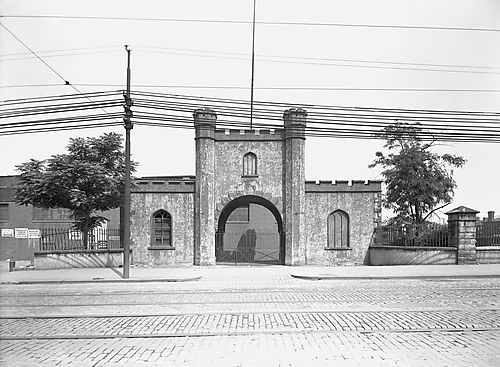
Allegheny Arsenal entrance on Penn Avenue, 1910.
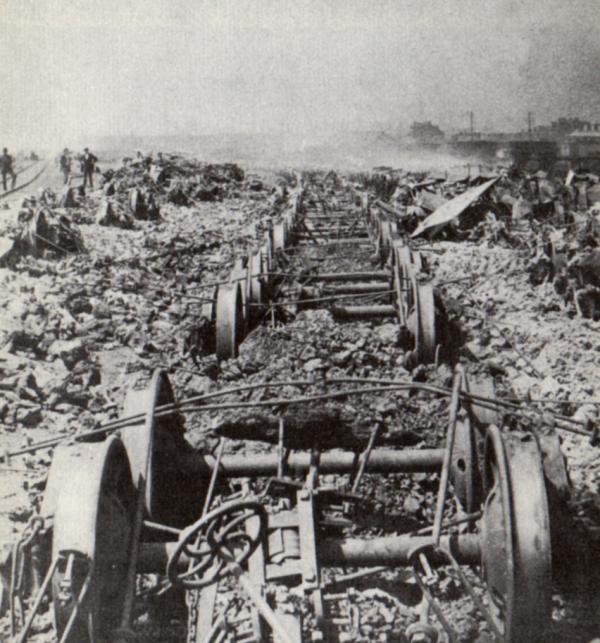
By 7:00 a.m. on July 22nd, the strike had spread to Allegheny City, and into the Borough of Millvale. Throughout the previous evening and night, more strikers had arrived from further outside of Pittsburgh. Other railroad workers from other railroads had also voted to join the strike. A large amount of the workers from between New York and Chicago were on strike. Looting of railroad cars and equipment had been burned. Below are some of the images of the fires and damage. Pittsburgh firefighters assisted by firefighters from Allegheny City had come to assist and were on duty for days during the strike, at that point, these firefighters were still volunteers and protected the fires from spreading to homes and businesses throughout the city.
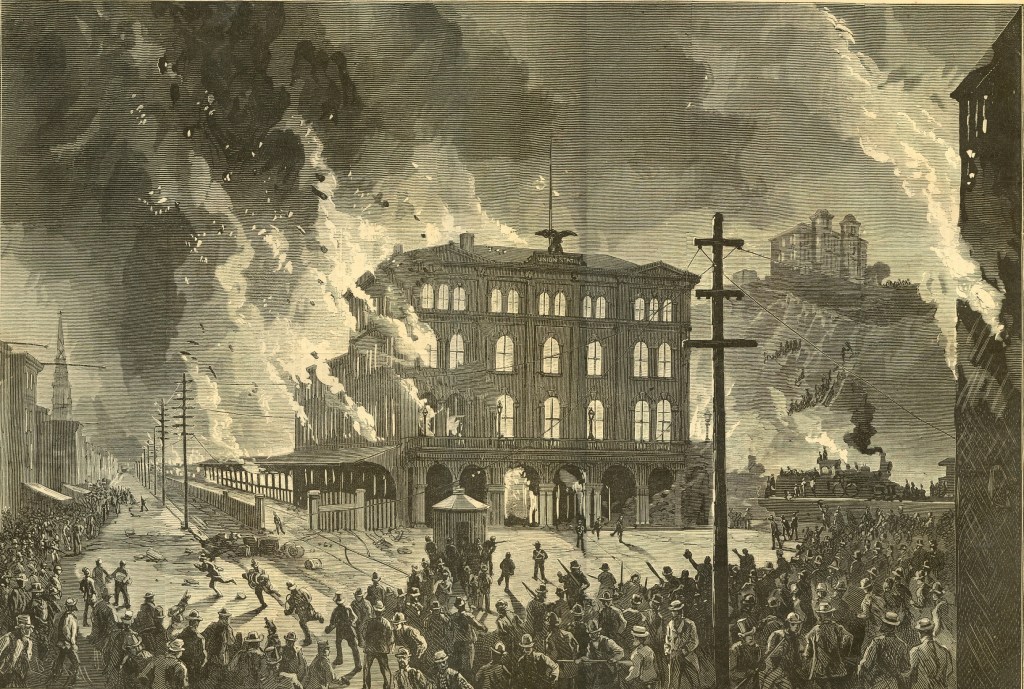
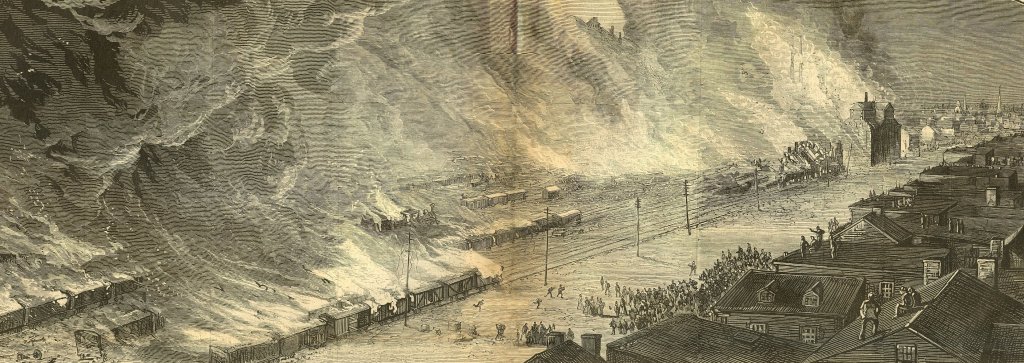
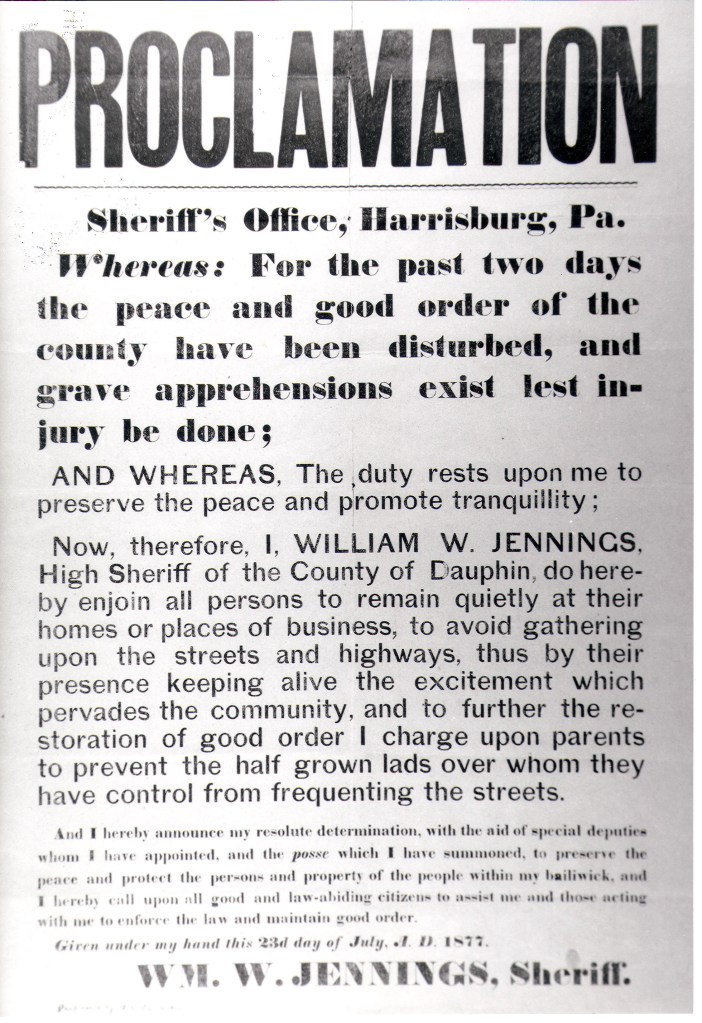
On July 23rd, few businesses in the city opened, tensions were still very high. Mayor McCarthy asked everyone to return to their homes and allow things to calm, and the firefighters to put out the fires. Over the next few days the stress in the city was palpable. On July 28th Pennsylvania Governor arrived in Pittsburgh with fresh troops from Philadelphia artillery pieces and two companies of Federal Troops. By July 30th, trains were again running on the tracks that were not damaged.
In all, nearly 40 buildings were destroyed, over 100 locomotives were made inoperable, and nearly 1500 train and passenger cars were destroyed. Among the strikers and their supporters, 59 were killed, and 109 were injured. Among the soldiers, 8 were killed and 15 were wounded. 139 arrests were made connected to the damage. The cost to the city was roughly $2 million, and the cost to the railroads was between $4 and $10 million. Congressional hearings and a state study would later look into the causes and results of the strike in Pittsburgh.
 The Magical History Tour
Leave a comment