(Author’s Note) The following is a short excerpt from my upcoming book on the forts of Western Pennsylvania. I am finishing the editing phase in hopes to have it in print sometime this summer.
In 1740, the British Parliament passed the Plantation Act, this law would contribute largely to the growth of population in British Colonial America. This act would naturalize every non-British Protestant person living in the colonies for seven years, and encourage migration from Britain and other British allied nations in Europe to the American colonies over the following years. The act required a declaration of allegiance to the British Monarchy, a profession of Christian Faith, and a payment of two shillings. Exceptions were made for Quakers and Jews who were held to all other requirements except the profession of faith; no exceptions were made for Catholics. The naturalization of Catholics was discouraged by the British Monarchy and Parliament though Protestants from other European kingdoms were encouraged.
This law and other laws enacted by the individual colonial governments, such as land grants, debt relief, indentured servitude, and religious freedoms excluding Catholicism, greatly increased migration from Europe to the colonies. This expansion westward also caused the colonies to begin expanding into uninhabited lands, and no treaties existed between the Native inhabitants of those lands and the colonial governments.
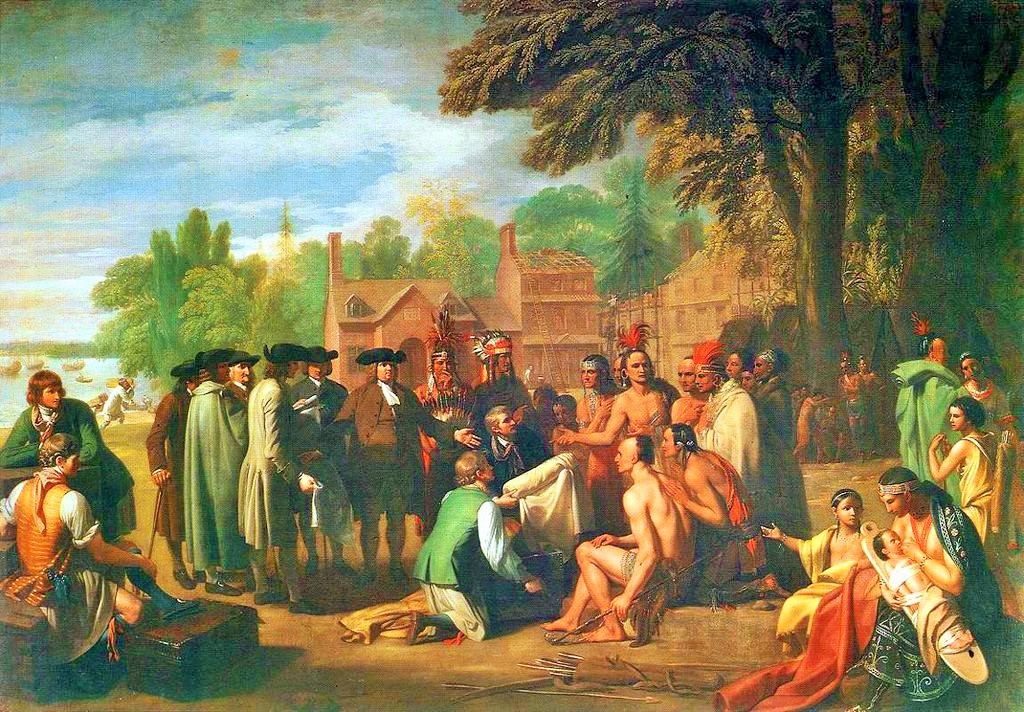
In 1682, William Penn entered into purchase agreements with the Lenape that brought lands deeded to his proprietorship under his absolute title.
When William Penn established the colony, he wanted to create a peaceable kingdom, as a Quaker, he felt it was important to work fairly and in peace with the Native population. In the Pennsylvania colony you begin to see a western progression of settlers, Pennsylvania largely negotiated the purchase of lands at fair market value for the period during William Penn’s proprietorship. The colony negotiated with Native groups to purchase these lands. Penn’s belief in fair trade of land would continue until his death. Penn’s sons Thomas, Richard, and John did not share his Quaker beliefs or his ideals of working fairly with the Native people to expand the colony. These Quaker qualities of William Penn would not continue with his sons, which would increase conflict with Native peoples significantly, especially with the Walking Purchase.
The Walking Purchase was a land deal between the Penn family and the Lenape people in 1737. The Penn family acquired 1.2 million acres of land in Pennsylvania, which was a significant portion of the Lenape’s hunting grounds. The Walking Purchase was a land fraud that led to violence between the Lenape and colonial settlers. In 1737, William Penn’s sons, Thomas, Richard, and John had gained proprietorship of the colony and had been living beyond their means and decided to use their proprietorship to make money by selling more land in the Pennsylvania colony. The Provincial Secretary, James Logan had already been selling land outside what had been agreed to by treaty. Logan was one of the largest land speculators in the colonies and was happy to work with Penn’s Sons to expand the colony. Logan and the Penn’s believed that they needed to extend their authority and provide government oversight in these new settlements. As a result, they considered it necessary to obtain a clear title from the Indians to the land in the upper Delaware and Lehigh River valleys. A document was produced stating that the land grant had been made in 1686 covering the lands that would soon be known as the Walking Purchase.
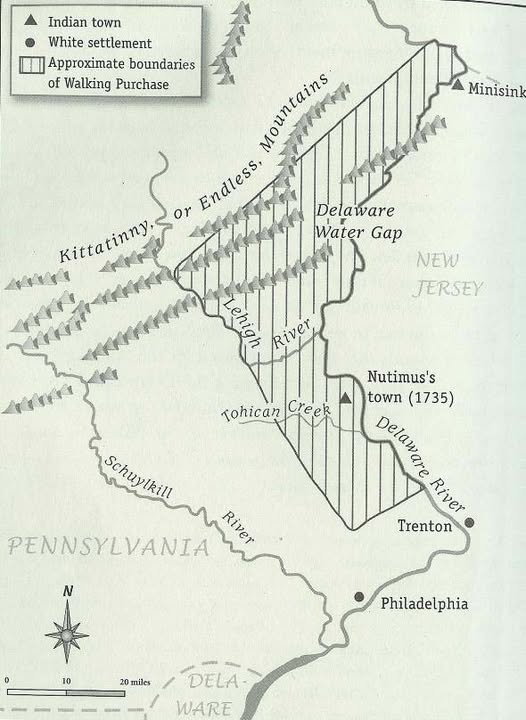
Map of the Walking Purchase
To promote their claim to the area, they showed to leaders of the Lenape’ living on this land a deed that they insisted proved William Penn had bought the land in 1686, stating that he had not paid for it because the land described in the deed had never been measured off to the satisfaction of all parties involved. Because the Lenape’ with whom Logan and the Penn brothers spoke had moved there from New Jersey, they knew nothing about the alleged 1686 purchase. The Lenape’ were subservient to the Haudemosaunee Confederacy during this time, so the Penn’s took their claim to the confederacy as well, which allowed the purchase to move forward. The Lenape’ attempted to secure help to resist the proprietors’ claims from the Haudenosaunee Confederacy to whom they were subservient due to the Lenape’ having lost their negotiation rights in war with the Haudenosaunne Confederacy. Logan composed a deed that the Haudenosaunee leaders signed giving up all Haudenosaunee interests in the area to prevent any interference in the sale. Lenape leaders were overwhelmed by the insistence of the Colonial leaders and without the support of the Haundeosaunee, the Lenape’ relinquished the lands on August 25, 1737.
The Walking Purchase and the growth of settlers arriving along the eastern part of the colony caused the Lenape’ and other Native groups to move to the west to avoid conflict and poor treatment from the colonial government and the increasing arrival of settlers
 The Magical History Tour
Leave a comment